I may have previously shared that while in Hawaii last August I got an abscess in a molar and had to get emergency palliative treatment. Since the endodontist didn't do a complete root canal (just enough to drain it and relieve the pressure), he gave me a prescription for antibiotics to keep the infection from growing until I got back home. I didn't use three pills at that time.
This week I started getting pain in the tooth next to the one that abscessed in Hawaii. Wednesday I called my dentist and they made an appointment for treatment on Monday. I'm not a big fan of waiting days and days for treatment when there is intense pain involved, but I couldn't break through that wall. I could go get it fixed somewhere else, but I'd have to pay the full amount on my own. So, in desperation I tried taking the antibiotics again. Voila! They worked quite quickly at reducing the swelling and headache, and I was able to get a good night's sleep. The Hawaii prescription had 1 refill, so today I had CVS call and transfer the prescription here so I could get enough more to carry me over until Monday. And that worked, too!
Hooray for our team! I may even go in to work tomorrow.
(And I did, too.)
Friday, November 23, 2012


Sunday, October 14, 2012
My weird medical problems season
WARNING: if you don't like photos of weird medical problems, don't look at the photo below!
Liz says that each Fall I have weird medical problems. She has a point. Last year my list included pneumonia, torn achilles tendon, and some other minor weird stuff. This year I got a new thriller - a wart growing very fast between my little toe and the next one. There isn't any extra room in there, so it was growing into me like a plantars wart, and it hurts! I could barely walk for a while. It is on its way out via a strong formula of salicylic acid that is supposed to burn off warts within 3 weeks. So what if it's been 6 and still has a way to go? At least I can walk again.
The latest is an encounter with a lurker in my garage. I have been aware I was sharing my work space with these sneeky little predators for several years now, but I haven't worried about them. They are affectionately known as brown recluse spiders and they mostly keep themselves out of the way. I was even aware that one of them had a web about a foot or so away from where I stand when I work at my lathe. That should be plenty of space, right?
Apparently not. Last Monday evening I worked out there and when I got inside my leg started to itch. There was a little red spot right at the top edge of my sock, and I thought it was a mosquito bite. It looked like a mosquito bite, it itched like one, and it acted like one for a couple of days, except that it itched like the dickens! Then I noticed that the red spot was growing.
It seems that a spider crawled onto my shoe and up my leg until it found a place to bite, and it probably crawled off again to watch and see if it was going to get the biggest hunk of meat it had ever tasted. At least, I think that's what happened because I never saw the actual offender. I suppose I will have to spray noxious poisons in my workshop and kill everything in there. Oh the agony!
The wound area was strange because the little red spot where the bite was, was right at the edge of the larger red area. By Friday it was so painful it kept me awake at night. Saturday I realized the red spot had grown to the size of a quarter or a bit larger, so I used an old Indian trick for measuring such things - I drew a circle around the red area with a pen. Good news! This morning it was clear that it was shrinking - not growing. However, there is a much larger area under it where there is swelling and that whole area is quite sensitive and itchy. I also drew a line around that area, with a green marker. I have concluded that I will likely survive another weird medical issue.
The question underneath all this is simply: What weird, obscure, seldom heard-of thing will crop up next in my Fall weird medical problems season?
 The dark red spot - the source - is at the top-left of the general red area. Ink marks where the red extended Sat. night and you can see that it has retracted a bit, although there are now small red spots just outside it, too. The green marks the underlying swelled area. Photo taken Sunday night.
Liz says that each Fall I have weird medical problems. She has a point. Last year my list included pneumonia, torn achilles tendon, and some other minor weird stuff. This year I got a new thriller - a wart growing very fast between my little toe and the next one. There isn't any extra room in there, so it was growing into me like a plantars wart, and it hurts! I could barely walk for a while. It is on its way out via a strong formula of salicylic acid that is supposed to burn off warts within 3 weeks. So what if it's been 6 and still has a way to go? At least I can walk again.
The latest is an encounter with a lurker in my garage. I have been aware I was sharing my work space with these sneeky little predators for several years now, but I haven't worried about them. They are affectionately known as brown recluse spiders and they mostly keep themselves out of the way. I was even aware that one of them had a web about a foot or so away from where I stand when I work at my lathe. That should be plenty of space, right?
Apparently not. Last Monday evening I worked out there and when I got inside my leg started to itch. There was a little red spot right at the top edge of my sock, and I thought it was a mosquito bite. It looked like a mosquito bite, it itched like one, and it acted like one for a couple of days, except that it itched like the dickens! Then I noticed that the red spot was growing.
It seems that a spider crawled onto my shoe and up my leg until it found a place to bite, and it probably crawled off again to watch and see if it was going to get the biggest hunk of meat it had ever tasted. At least, I think that's what happened because I never saw the actual offender. I suppose I will have to spray noxious poisons in my workshop and kill everything in there. Oh the agony!
The wound area was strange because the little red spot where the bite was, was right at the edge of the larger red area. By Friday it was so painful it kept me awake at night. Saturday I realized the red spot had grown to the size of a quarter or a bit larger, so I used an old Indian trick for measuring such things - I drew a circle around the red area with a pen. Good news! This morning it was clear that it was shrinking - not growing. However, there is a much larger area under it where there is swelling and that whole area is quite sensitive and itchy. I also drew a line around that area, with a green marker. I have concluded that I will likely survive another weird medical issue.
The question underneath all this is simply: What weird, obscure, seldom heard-of thing will crop up next in my Fall weird medical problems season?
The dark red spot - the source - is at the top-left of the general red area. Ink marks where the red extended Sat. night and you can see that it has retracted a bit, although there are now small red spots just outside it, too. The green marks the underlying swelled area. Photo taken Sunday night.
Saturday, September 1, 2012
We are back from Hawaii
We had a great time on The Islands. We swam in the open ocean with a pod of untrained dolphins, we visited Pearl Harbor, we boogie boarded,
kayaked, and swam in the warm ocean. We gloried in the greenery and the
flowers. One of the funnest things we did was spend an afternoon at
the Polynesian Cultural Center on Oahu. They bring young people from
all the Islands of the Pacific to Hawaii to go to college, and they have
the opportunity to work there to pay their way. We sat and watched as
boats came along a canal with performers on them, doing native dances
from the various islands. We saw these hula girls coming and briefly
wondered if the girls still know how to really hula. Shortly after they
started, Liz commented, "These girls have it figured out." and they
did!
I wish we had photos of the dophins. At one point, I thought about getting some waterproof cameras to take with us on the boat, but I didn't carry through, and I am actually glad, because it would have distracted us from watching them. There was a pro photographer with us and she was selling DVDs with photos and videos of the whole thing for $55, which I wish we'd bought. Anyway, one of the cool things with this pod was that they had several small calves, including one little fellow who sadly had a bite cut in his side from a shark. The rest of the pod must have rallied around him to beat other sharks away after that. He seemed to be doing fine.
Our last day on the Island we visited the National Tropical Botanic Garden. It was great, but there was a curious fountain there. It looks kind of tame at first. It is a long (about 40 yards), narrow fountain with alternating narrow and wide areas, and the whole thing drops a total of only 2 inches. The water flows into it at a constant rate, but as it passes along it starts a wave action and the water pulses as it leaves the fountain. You have to have a lot of money to build a fountain for the novelty of having it pulse at one end, but it was way cool.
They filmed part of Jurassic Park there, including the scene where they are snuggled into the roots of a big tree and then find hatched out raptor eggs on the ground as they leave. I saw the very spot where the eggs were - it is right under the hand of the park guide who is pointing off to the side. The trees have grown some since that movie was made. There are places where you can follow the roots up to the bole of the tree and are hidden from everybody unless they are right in front of you.


A hundred yards away, they filmed part of Pirates of the Caribbean IV where Captain Sparrow and friends waded across a little river to invade a pirate camp. They start out in the bamboo grove you can see on the right side of this photo, and end up in a clearing on the other side. In that scene, you briefly see this distinctive coconut tree leaning across the river.

Saturday, May 5, 2012
The Queen is dead. Long live the Queen.
I captured a swarm this spring, and it turned out to be Africanized. It is all the queen's fault, because she is the mother of all the mean little heathenish girls in the hive.
 I ordered a new queen, which arrived promptly and in good shape. Here is the cage she was shipped in. It is simply stapled to the inside of a paper priority mail envelope and sent off. There are a few worker bees in there with her, because she can't feed herself, or clean herself, or do any of the other normal maidenly things most bees do.. It takes a while to get a hive to accept a new queen, so the cage has a big blob of candy at one end. After the bees in the hive eat all the candy, the hole that is left will let the queen escape. By then, the hive should be used to her distinct pheromone and will accept her as their new matriarch. I left the queen in her cage, between two frames of honeycomb, where the hive bees can get at the candy and release her
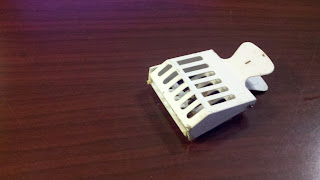
Of course the hive won't accept the new queen if their old, trusted queen is still around, so, I captured the old, Africanized queen with a queen catcher. You can pick them up with your fingers, but this device is more gentle. You simply squeeze it to open it, slip it over the top of the queen, and let it close around her. The slots are scientifically sized so that worker bees can escape, but queens full of eggs cannot.
 After I got her home, I released her on my desk for a publicity shoot. Queens can fly, but when they are full of eggs like this one is, they are heavy and can't fly very well. I like queen bees. They have a beautiful, golden color and seem to glow in the sun. And they are gentle as little lambs. Pity her daughters are such nasty brutes. I let this one run around on my hand and arm for a while, just to prove how gentle and meek they are. Queen bees never sting to defend themselves. They are only known to sting other queens. It is a very good thing they don't sting beekeepers, because they have a wicked long stinger! But bee stingers are actually ovipositers (that means it is the tube used to lay eggs.) Worker bees don't oviposit as long there is a queen in the hive, so they are free to use theirs as a stinger. The queen, though, uses hers for laying eggs, hundreds of times a day this time of year.


Of course the hive won't accept the new queen if their old, trusted queen is still around, so, I captured the old, Africanized queen with a queen catcher. You can pick them up with your fingers, but this device is more gentle. You simply squeeze it to open it, slip it over the top of the queen, and let it close around her. The slots are scientifically sized so that worker bees can escape, but queens full of eggs cannot.

 After I got her home, I released her on my desk for a publicity shoot. Queens can fly, but when they are full of eggs like this one is, they are heavy and can't fly very well. I like queen bees. They have a beautiful, golden color and seem to glow in the sun. And they are gentle as little lambs. Pity her daughters are such nasty brutes. I let this one run around on my hand and arm for a while, just to prove how gentle and meek they are. Queen bees never sting to defend themselves. They are only known to sting other queens. It is a very good thing they don't sting beekeepers, because they have a wicked long stinger! But bee stingers are actually ovipositers (that means it is the tube used to lay eggs.) Worker bees don't oviposit as long there is a queen in the hive, so they are free to use theirs as a stinger. The queen, though, uses hers for laying eggs, hundreds of times a day this time of year.
Saturday, April 28, 2012
The bees are here!
The package bees arrived Thursday. I called the post ofc. and asked them to hold the bees at the P.O., but the carrier delivered them anyway. Fortunately, it was a cloudy day, because the afternoon sun really beats into our porch in the afternoon, sufficient to smother a bunch of closely packed, agitated bees. But they are fine, happily settling into their new homes.
 This
photo shows the shipping cages they came in. The sticks on top held
the two cages about 3 inches apart, so air could get to both (I had to break the sticks to get them apart. Each cage
held 3 lbs. of bees - several thousand - and a queen in a separate cage
to ensure she traveled safely. The big hole had a little can of sugar
syrup so they wouldn't get hungry, and it was held in place with a piece
of cardboard stapled over the top.
This
photo shows the shipping cages they came in. The sticks on top held
the two cages about 3 inches apart, so air could get to both (I had to break the sticks to get them apart. Each cage
held 3 lbs. of bees - several thousand - and a queen in a separate cage
to ensure she traveled safely. The big hole had a little can of sugar
syrup so they wouldn't get hungry, and it was held in place with a piece
of cardboard stapled over the top. The bee yard looks a little cluttered from here. The first hive is one of the new ones. They are working on building their comb in the white box. The tan box has a big tub of syrup, which will let them build up quicker than if they had to go visit flowers.
There is an empty hive just beyond the first hive, and then the other package bee hive. Beyond that is the Africanized beehive which I have to move out of the city, and it has some black plastic tubs with beeswax in them. I was hoping they would get hot enough to melt and purify the wax, but not so.
Saturday, March 10, 2012
The bees will live again.
My children did a very embarrassing thing: they pitched in and raised money for me to buy new honeybees. It was a kindly thing. But it was embarrassing. Still, they gave me the impetus to start over again, so I ordered two packages of bees from R. Weaver Co. The anticipated ship date is April 24. Weavers sell 3 lbs. packages, while most breeders only send 2 lbs. What this means is that in addition to a proven queen bee, there are 3 lbs. of worker honeybees in the package. More bees means they can gather nectar and pollen faster, build comb sooner, and raise more young bees. The result should be fast build-up of the new colony and a chance (slim) of some surplus honey this year. "Surplus" honey is what the beekeeper steals for his own use.
I was able to save some comb the bees can use to raise their new bees, which will be a plus for them. Most packages are installed into new hives where the bees have to make the new comb before raising young and storing honey. These bees will have a head start, IF the old comb doesn't still stink so bad from being in the muddy water that they reject it. If they reject the comb, they will probably fly away and find a new home with more friendly surrounds. That would be bad, but: "You never know about bees" (quote from Winnie the Pooh and The Honey Tree.) I have found wild bees living in an old 5 gal. gas can that still reeked of gas fumes.
On another note, Liz and I bought a new bed sans box springs. I have long held the opinion that box springs are a money waster left over from the days before modern materials. I have wanted to build a torsion box bed foundation. We didn't do that, because Liz is convinced it would squeak. Instead, we bought a steel frame to hold up a 12" thick memory foam mattress. There is more than average storage room under this frame, but not quite enough for the bins Liz wanted to put under it. I solved that problem by cutting some rounds of wood to lift each leg up 2 1/2" above the carpet (see below.) The trouble was that the legs tended to slip off the rounds, which then made the bed go all ahoo (technical term from my Marine days.)
Yesterday, I bought 2X4's and made new supports that are more solid, and have recesses to hold the legs firmly in place.
 I rounded the ends of the supports to minimize toe stubbing.
On the floor, you can see one of the rounds that previously raised the legs. Behind the new supports are the bins. Among other things, the bins will hold the non-Christmas holiday decorations.

This is the bed as it looks when you enter the room. The height is nearly the same as it was with the old box springs, and a skirt hides the storage.
I was able to save some comb the bees can use to raise their new bees, which will be a plus for them. Most packages are installed into new hives where the bees have to make the new comb before raising young and storing honey. These bees will have a head start, IF the old comb doesn't still stink so bad from being in the muddy water that they reject it. If they reject the comb, they will probably fly away and find a new home with more friendly surrounds. That would be bad, but: "You never know about bees" (quote from Winnie the Pooh and The Honey Tree.) I have found wild bees living in an old 5 gal. gas can that still reeked of gas fumes.
On another note, Liz and I bought a new bed sans box springs. I have long held the opinion that box springs are a money waster left over from the days before modern materials. I have wanted to build a torsion box bed foundation. We didn't do that, because Liz is convinced it would squeak. Instead, we bought a steel frame to hold up a 12" thick memory foam mattress. There is more than average storage room under this frame, but not quite enough for the bins Liz wanted to put under it. I solved that problem by cutting some rounds of wood to lift each leg up 2 1/2" above the carpet (see below.) The trouble was that the legs tended to slip off the rounds, which then made the bed go all ahoo (technical term from my Marine days.)
Yesterday, I bought 2X4's and made new supports that are more solid, and have recesses to hold the legs firmly in place.
 I rounded the ends of the supports to minimize toe stubbing.
On the floor, you can see one of the rounds that previously raised the legs. Behind the new supports are the bins. Among other things, the bins will hold the non-Christmas holiday decorations.
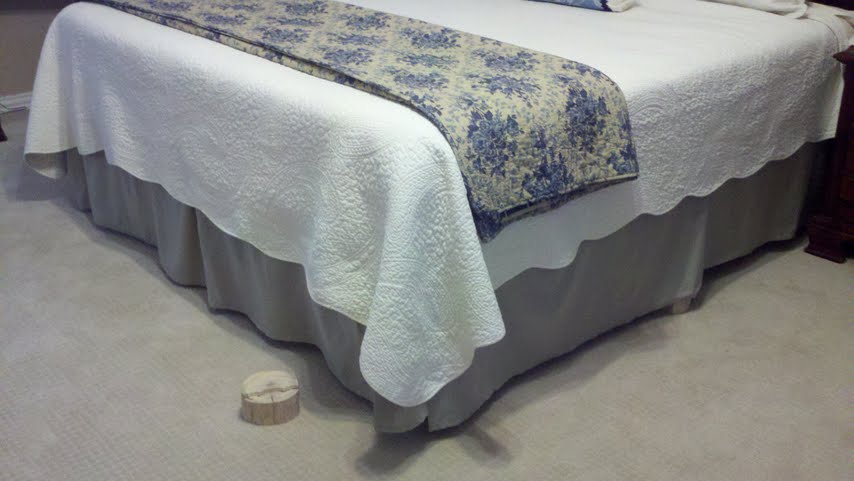
This is the bed as it looks when you enter the room. The height is nearly the same as it was with the old box springs, and a skirt hides the storage.
Thursday, March 1, 2012
Ding dong, the bees are dead.
It is a sad, sad day at the apiary! We are mourning the passing of 120,000 (give or take) brave worker bees and 4 righteous queens who tragically died in the muddy waters of a Texas flood. They were abandoned to their horrible fate by a careless beekeeper, may he rot in the nether regions, who underestimated the depths to which Texas floodwaters may gather without warning or precursor. As the Trinity river swelled and water backed into tributaries, our brave honeybees, also known as Apis Melifora Multitudinous, were trapped as the rising waters first confined them to their hives, and then rose to drown them. Also lost were numerous eggs and larva, helpless children of the long suffering queens in this tragic tale. Property damage included honey, gathered after much toil and hard work into the comb, as well as pollen which would have been used to feed the poor, drowned larva.
Preceding the honeybees in death were 150,000 worker bees and 5 queens who fell victim to last Fall's hot and dry weather, denying them the nectar which would normally have come forth in floral blooms, the source of honey that could have enabled them to survive a long, though warm, winter.
Memorial services were held this morning in Sterling, Va. at the Worth family home. "Grandpa's honey was the best!" said one fan.
Below is a photo of one of the honeycombs recovered from the scene of the tradegy. Normally, the honeycomb would be a pleasant yellow color from the wax.

Well, enough of that. The question is to rebuild, or not to rebuild. This is a tough question for me, right now. Here are the factors:
Preceding the honeybees in death were 150,000 worker bees and 5 queens who fell victim to last Fall's hot and dry weather, denying them the nectar which would normally have come forth in floral blooms, the source of honey that could have enabled them to survive a long, though warm, winter.
Memorial services were held this morning in Sterling, Va. at the Worth family home. "Grandpa's honey was the best!" said one fan.
Below is a photo of one of the honeycombs recovered from the scene of the tradegy. Normally, the honeycomb would be a pleasant yellow color from the wax.

Well, enough of that. The question is to rebuild, or not to rebuild. This is a tough question for me, right now. Here are the factors:
- When Liz retires (probably 5 years or so from now) we will probably move closer to our kids in Utah, and no Texas bees can be taken to Utah because we have Africanized honeybees and Utah does not - Yet. So is it worth it to build up my apiary again, only to have to abandon it again?
- The comb is a beekeepers most valuable asset. I recovered all the honeycomb and most of the equipment, then spent all day yesterday cleaning comb out. I have as much more work to do to complete the task. However, as the photo above shows, the comb is filled with muddy water, and it STINKS! Texas has so very many wild pigs, and flood waters tend to collect where the pigs do, so the mud smells like the back part of a pig pen where they do their daily business. It is awful! So I am not sure I want to have the least trace of that in my honeycomb, especially if it will hold honey that may end up on my table. So, even though I have put a lot of effort into salvaging the comb, I think it is best to discard it, or perhaps to melt the wax down if it doesn't smell too bad.
- I am not currently working, making money tight. If I got new bees from a breeder (R. Weaver Co. is my favorite) a package with queen and enough bees to start one hive will cost me $120 plus shipping and insurance, probably about $150 total. And it is very risky to get only one package of bees. It is considered that 2 packages is the minimum to safely start. That would be $300 and is beyond my reach at the moment.
- I could set out some hives with pheromone lures to try to gather in a wild swarm or two. Swarms wouldn't produce much honey this year, but they would build up enough to be ready to produce next year. The cost is much lower and the chances of success are good, but the likelihood of gathering in Africanized bees is quite high. I have had Africanized bees take over a few hives in the past few years and I don't like it. I am a gentle person, and Africanized bees are not gentle. It isn't a good match.
- I love having fresh honey to sell or give away every year. It gives me a feeling of real worth to share the bees' bounty. I keep some for my own table, but I have always given away more than I've kept for myself. In recent years, as I started producing more I have sold some of it for a nominal price to defray the cost of bottles, but I prefer to give it away. It would make me very sad to think of not having any more honey from my own hives.
- I have a pretty large investment in equipment. I have forms for assembling new hive boxes and honeycomb frames. I have plans I've collected over the years for making hives and wax separators and bee vacuums, etc. I have a centrifugal honey extractor, and buckets and valves and strainers for bottling the honey. I have factory-made frame parts, and special staples for holding hives together, and honeycomb foundation. I have bee suits and veils, and hive tools, and smokers, and all the paraphernalia of beekeeping. If I didn't have bees, it would all become junk, at best to be sold for a small fraction of what it is worth.
- And finally, as much as we like to think that who we are is separate from what we do, keeping bees is part of my identity and I just don't want to give it up. I AM one of those crazy people who will happily go into a bee yard knowing in advance that I WILL get stung. I not only don't mind getting stung, I expect and demand to get stung. How can I give that up?
So, I think I have to continue on. I will try for a swarm or two, and maybe next year I will have honey to share once again.
Subscribe to:
Posts (Atom)
