Saturday, March 10, 2012

The bees will live again.

My children did a very embarrassing thing: they pitched in and raised money for me to buy new honeybees. It was a kindly thing. But it was embarrassing. Still, they gave me the impetus to start over again, so I ordered two packages of bees from R. Weaver Co. The anticipated ship date is April 24. Weavers sell 3 lbs. packages, while most breeders only send 2 lbs. What this means is that in addition to a proven queen bee, there are 3 lbs. of worker honeybees in the package. More bees means they can gather nectar and pollen faster, build comb sooner, and raise more young bees. The result should be fast build-up of the new colony and a chance (slim) of some surplus honey this year. "Surplus" honey is what the beekeeper steals for his own use.
I was able to save some comb the bees can use to raise their new bees, which will be a plus for them. Most packages are installed into new hives where the bees have to make the new comb before raising young and storing honey. These bees will have a head start, IF the old comb doesn't still stink so bad from being in the muddy water that they reject it. If they reject the comb, they will probably fly away and find a new home with more friendly surrounds. That would be bad, but: "You never know about bees" (quote from Winnie the Pooh and The Honey Tree.) I have found wild bees living in an old 5 gal. gas can that still reeked of gas fumes.

On another note, Liz and I bought a new bed sans box springs. I have long held the opinion that box springs are a money waster left over from the days before modern materials. I have wanted to build a torsion box bed foundation. We didn't do that, because Liz is convinced it would squeak. Instead, we bought a steel frame to hold up a 12" thick memory foam mattress. There is more than average storage room under this frame, but not quite enough for the bins Liz wanted to put under it. I solved that problem by cutting some rounds of wood to lift each leg up 2 1/2" above the carpet (see below.) The trouble was that the legs tended to slip off the rounds, which then made the bed go all ahoo (technical term from my Marine days.)
Yesterday, I bought 2X4's and made new supports that are more solid, and have recesses to hold the legs firmly in place.
I rounded the ends of the supports to minimize toe stubbing.
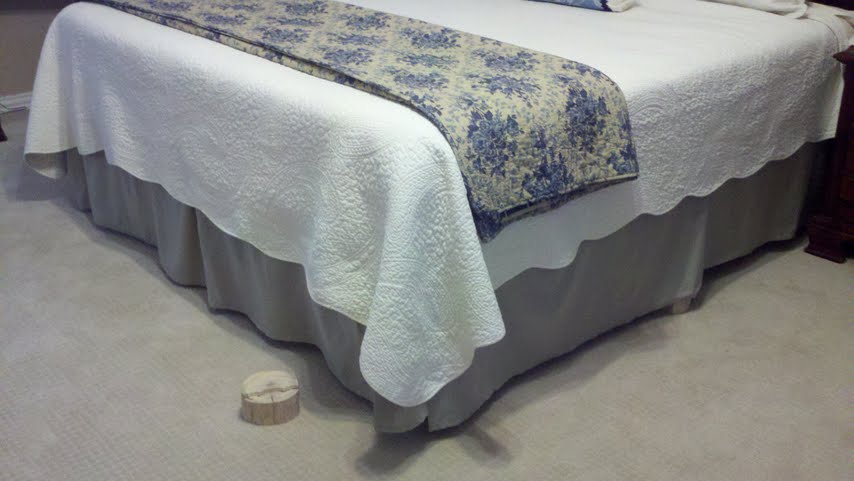
On the floor, you can see one of the rounds that previously raised the legs. Behind the new supports are the bins. Among other things, the bins will hold the non-Christmas holiday decorations.


This is the bed as it looks when you enter the room. The height is nearly the same as it was with the old box springs, and a skirt hides the storage.

Thursday, March 1, 2012

Ding dong, the bees are dead.

It is a sad, sad day at the apiary! We are mourning the passing of 120,000 (give or take) brave worker bees and 4 righteous queens who tragically died in the muddy waters of a Texas flood. They were abandoned to their horrible fate by a careless beekeeper, may he rot in the nether regions, who underestimated the depths to which Texas floodwaters may gather without warning or precursor. As the Trinity river swelled and water backed into tributaries, our brave honeybees, also known as Apis Melifora Multitudinous, were trapped as the rising waters first confined them to their hives, and then rose to drown them. Also lost were numerous eggs and larva, helpless children of the long suffering queens in this tragic tale. Property damage included honey, gathered after much toil and hard work into the comb, as well as pollen which would have been used to feed the poor, drowned larva.
Preceding the honeybees in death were 150,000 worker bees and 5 queens who fell victim to last Fall's hot and dry weather, denying them the nectar which would normally have come forth in floral blooms, the source of honey that could have enabled them to survive a long, though warm, winter.
Memorial services were held this morning in Sterling, Va. at the Worth family home. "Grandpa's honey was the best!" said one fan.


Below is a photo of one of the honeycombs recovered from the scene of the tradegy. Normally, the honeycomb would be a pleasant yellow color from the wax.

Well, enough of that. The question is to rebuild, or not to rebuild. This is a tough question for me, right now. Here are the factors:
  1. When Liz retires (probably 5 years or so from now) we will probably move closer to our kids in Utah, and no Texas bees can be taken to Utah because we have Africanized honeybees and Utah does not - Yet. So is it worth it to build up my apiary again, only to have to abandon it again?
  2. The comb is a beekeepers most valuable asset. I recovered all the honeycomb and most of the equipment, then spent all day yesterday cleaning comb out. I have as much more work to do to complete the task. However, as the photo above shows, the comb is filled with muddy water, and it STINKS! Texas has so very many wild pigs, and flood waters tend to collect where the pigs do, so the mud smells like the back part of a pig pen where they do their daily business. It is awful! So I am not sure I want to have the least trace of that in my honeycomb, especially if it will hold honey that may end up on my table. So, even though I have put a lot of effort into salvaging the comb, I think it is best to discard it, or perhaps to melt the wax down if it doesn't smell too bad.
  3. I am not currently working, making money tight. If I got new bees from a breeder (R. Weaver Co. is my favorite) a package with queen and enough bees to start one hive will cost me $120 plus shipping and insurance, probably about $150 total. And it is very risky to get only one package of bees. It is considered that 2 packages is the minimum to safely start. That would be $300 and is beyond my reach at the moment.
  4. I could set out some hives with pheromone lures to try to gather in a wild swarm or two. Swarms wouldn't produce much honey this year, but they would build up enough to be ready to produce next year. The cost is much lower and the chances of success are good, but the likelihood of gathering in Africanized bees is quite high. I have had Africanized bees take over a few hives in the past few years and I don't like it. I am a gentle person, and Africanized bees are not gentle. It isn't a good match.
  5. I love having fresh honey to sell or give away every year. It gives me a feeling of real worth to share the bees' bounty. I keep some for my own table, but I have always given away more than I've kept for myself. In recent years, as I started producing more I have sold some of it for a nominal price to defray the cost of bottles, but I prefer to give it away. It would make me very sad to think of not having any more honey from my own hives.
  6. I have a pretty large investment in equipment. I have forms for assembling new hive boxes and honeycomb frames. I have plans I've collected over the years for making hives and wax separators and bee vacuums, etc. I have a centrifugal honey extractor, and buckets and valves and strainers for bottling the honey. I have factory-made frame parts, and special staples for holding hives together, and honeycomb foundation. I have bee suits and veils, and hive tools, and smokers, and all the paraphernalia of beekeeping. If I didn't have bees, it would all become junk, at best to be sold for a small fraction of what it is worth.
  7. And finally, as much as we like to think that who we are is separate from what we do, keeping bees is part of my identity and I just don't want to give it up. I AM one of those crazy people who will happily go into a bee yard knowing in advance that I WILL get stung. I not only don't mind getting stung, I expect and demand to get stung. How can I give that up?

So, I think I have to continue on. I will try for a swarm or two, and maybe next year I will have honey to share once again.

Friday, February 10, 2012

Making things with wood.


I love making things with wood. It is challenging and sometimes frustrating, but I still love it. I enjoy solving problems, and that is often what makes challenging projects fun. But what makes me happiest is when I put the finish on.

This photo shows two identical boards - the two sides of a box. They were made from the same piece of wood, but one has a coat of boiled linseed oil on it, while the other is still raw, sanded smooth, but unfinished. It is a wonder to see how the oil brings out the color of the wood and transforms it into a thing of beauty.

Friday, February 3, 2012

Spring

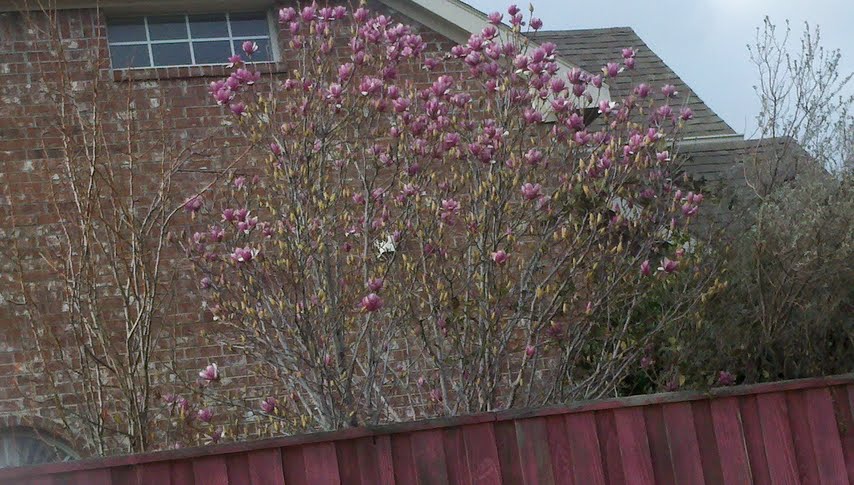
Spring comes sooner down here in the flatlands than it does for most of you mountainous readers. Still, it is a nice thing to see it coming, even if you live a mile high in the rockies. I try to keep an eye out for signs of spring, but I hadn't even started looking this year. Imagine my surprise when I had to run to the corner store for a bag of flour and saw this tree on the way home? This tulip tree is always the first tree in our neighborhood to bloom. It is on the south side of its house, with a street to the south of that, so it gets lots of sun, and reflected sun.


After I passed it I saw signs of another tree budding out, with little boys happily playing on the dead grass underneath its spreading, barren bows.

As I neared home, I saw with wonderment that dandelions were blooming in a neighbor's yard! And even more, when I got home I saw that dandelions are blooming in my own yard, in the midst of those little spreading weeds with the tiny purple flowers, which are quite beautiful if you get down on your hands and knees in the mud, put your nose right to the ground, and peer closely at them.


Yes, spring is just around the corner.


It is a good thing spring is coming. We had drought conditions last fall, so my honeybees didn't get very much nectar to store up for the winter. I had 6 colonies of bees last fall, but 2 of them died out during the winter, so now I only have 4. I had to feed my bees this year to get them through the winter, for the first time in about 6 or 7 years. But now, it looks like the surviving colonies will be OK to go. Yippee!
And the loss of 2 colonies is not such a big deal, because 2 of the survivors are bursting with bees and they will want to swarm pretty soon - maybe the end of the month. So I'll just split them, and I'll be back to 6 hives. Perfect.

Sunday, November 6, 2011

Skin Cancer


I knew it was likely to happen some day, and yesterday I got the news. I have a melanoma - the kind of skin cancer can get to be aggressive and can kill you. Fortunately, mine is not yet in the aggressive state. I will get it surgically removed Tuesday and be OK. My dermatologist says that this means I need to warn all my kinfolk to get regular dermatology checkups because it often runs in families.

The attached photo shows the actual bugger on my upper arm, but I need to explain. First, the depressed area in the center is from where they biopsied it - before that, it was just a red patch of skin - not dark like they often are, didn't stand up at all and didn't seem to have any depth. Second, the red square around it is irritation from the bandaids I've been wearing to keep the antibiotic ointment on it so it could heal from the biopsy.
The thing is that it didn't really look like melanomas usually do. You use ABCDE to identify melanomas (before you biopsy).
  • A - Asymmetrical Shape. Mine is pretty much circular.
  • B - Border. They usually have an irregular border, but mine has a smooth border.
  • C -Color. "The presence of more than one color (blue, black, brown, tan, etc.) or the uneven distribution of color can sometimes be a warning sign of melanoma." Mine is just a uniform pink.
  • D - Diameter. Usually 6mm or larger, about the size of a pencil eraser. I don't know why they use the eraser for this, the other end is the same size. Anyway, mine fit this one. It's about 8mm.
  • E - Evolution. "The evolution of your moles(s) has become the most important factor to consider when it comes to melanoma. Knowing what is normal for YOU could save your life. If a mole has gone through recent changes in color and or size, get it checked out by a dermatologist immediately." This thing appeared very suddenly on my arm where there had been nothing before. No mole.
So my melanoma only fit 1 of the 5 signs. I already knew about ABCDE, but this one didn't alarm me much, because it isn't typical. When Dr. Poliak saw it, she gave a little gasp and said, "Oh! What's this?" Like I would know. All I knew was that it was an odd little thing. It appeared very suddenly. It wasn't there and then it was. It stayed unchanged for quite a while - several months - maybe a year. She didn't say anything, but after the biopsy results came back, she told me she thought it was a melanoma all along. That's why we have dermatologists, to not be fooled by little red circles. She also said that when melanoma runs in a family, then they see ones like mine that aren't so typical.

So, all my children: Go see a dermatologist to get a baseline, and then go back periodically for checkups.

Friday, October 28, 2011

New Year

Well, it's not exactly New Year, but it's reminiscent of New year, so close enough.
Actually, it was about 1 year ago that I started the kitchen remodeling project, which I was putting paint on when people started arriving for Liz's Mom's funeral, which launched us into the master bedroom remodel, and moving into our restored master bedroom launched an upstairs bedrooms re-arrangingl, and then I finally put up the last piece of crown molding on the kitchen remodel that started it all. So it has been a busy year in that respect.

But, what really has me thinking is all the personal changes I've made this last year. Most of them are good, but they are really just life moving along. So here they are:
  1. I had a seriously Africanized beehive out at the Hubers, which scared me enough that I moved the bees I've kept at our house for the past 10 year or so out to a remote part of the Texas hinterland, along with all my other bees. Now I have all of them out there - 8 hives. I re-queened the Africanized one and hopefully that will settle them down for a year or so.
  2. About that same time I finally put too much strain on my achilles tendon and it partially ruptured. I spent 3 months in a boot for it to heal. It did heal, mostly, but then in a careless moment I re-injured it and it was worse than the first time. So, in the next couple of weeks, I will have a procedure down to break apart all the scar tissue in it, after which I will be on crutches for a month to 6 weeks, and then I should get better. Meanwhile, the other achilles tendon is taking a beating from the extra strain on it. "Oh, the humanity!"
  3. I have always loved candy, and I have had the habit of having some almost every night while watching TV or whatnot. Late last year I decided it wasn't good for me, so I gave it up. Cold Turkey! I just quit. It wasn't a big decision, I still have a bag of lifesavers I bought last year. I still have jaw breakers I bought last year when we went to Branson.
  4. Recently, I gave up Pepsi. I know, I've done that before and slid back into it. I didn't really decide to give up Pepsi this time, but I didn't drink it one day and after the headache started I thought I might as well quit. The difference this time is that I was less determined to do it, but now I don't seem to crave it like I've done before. I've been drinking lots of water, and that seems to help, too. By the way, quitting a caffeine habit gives you a few days of headaches. This time it was about 4 days, and it wasn't very fun. I think I'm not going to do that again.
  5. I stopped overeating so much. Again, no big decision, I just decided I didn't have to clean everything off my plate - it's OK to stop eating when I've had enough. I've lost some weight over this, but not much yet. But I feel better.
  6. I have stopped staying up late every night. I go to bed with my dear one at about 10:30 and I get up when she does. It has been nice and we both enjoy being on the same schedule. Side note: I still watch movies.
  7. We decided that cable TV was just too expensive, so we discontinued it. The hard part of it was that giving it up also meant giving up football, and that was HARD! I love watching football. But I haven't actually found it to be all that difficult, after all. The real driving point on this whole thing was that one day WOOT.com had Roku devices on sale for about $40. Roku is a little black box that receives wireless internet and streams movies and stuff to your TV. Once you have the box and wireless internet, you can watch movies and live streaming TV. So we can get BYU TV for conference and religious stuff, and we signed up for Netflix for movies. And that's it. By the way, I still watch movies.
  8. I have been buying flowers for Liz every once in awhile. I don't know why it took me 40 years to figure this out, but Liz really seems to think it's neat to have flowers show up occasionally. Go figure!
So, I feel like my life has changed quite a bit this year, and mostly it has been positive. I'd like to say that I've had some big revelation or life-changing experience, but it has just been a year of little changes and it occurred to me the other day that there have been quite a few of them.
It scares me a little bit, because sometimes you feel like if you get everything going just right, something has to break or God will call you home, or something. I hope not, because I am enjoying life right now and I'd like it to stay this way.

Now if I could just get us moved to Utah where I can plant an orchard and harvest fruit in my old age.

Sunday, September 11, 2011

Stake Conference talk - Sept. 11, 2011

My topic today is Lifelong Education.

You young people are fully involved with your education, so my topic necessarily makes me focus on continuing education AFTER you leave school. But, to you young people I say this one thing – if there is one subject you really want to try but it isn’t in your regular course of study, figure out a way to TAKE IT! I always wanted to try out fencing, but for various reasons I didn’t. I should have. For you, there will never be a better time.

So, I have 4 things to say about Life-long education:

1. It’s not too late and your mind works fine

2. It’s all about interest

3. There are more ways to skin a cat than with a dull butter knife

4. Why bother?

First thing: It’s not too late and your mind works fine

When I was young, I was thrilled to be able to go to BYU. We lived about 90 miles from the Y, in a very small town. Provo was like a dream for me, and I loved every minute of it.

My second year at the Y was my Mother’s first year going back to school. She had been there as a young woman, earned her teaching certificate, and was teaching school when she met my father. But she only had a 2-year degree and wanted to get a bachelor’s degree. It was a tough decision to go back, especially since she still had kids at home. The three youngest ones, especially, worried her. She felt like she might be abandoning them. In the end it was arranged and my youngest sister came to the Y with Mom while my youngest brothers stayed with Dad, along with the older kids. Mom missed them terribly while she was away.

Mom was scared of whether she could complete college courses at her age – she was in her 50’s then.

I saw Mom on campus fairly often, which was great. We settled in to the regular grind of classes and studying.

Mom put me to shame with how hard she studied. She focused on her school work so much that she had no social life beyond Suzy and me. That first semester she was learning how to be a student and at first her grades were only acceptable. After that she hit her groove and got A’s. She fussed and worried one time when she got an A-.

The next year, I started my hitch in the Marine Corps, married Liz, and came back to the Y in December, three years later. My first semester back at the Y was my Mom’s last, so Liz and I were there for her graduation. The college reserved a row for us at commencement. During the program, the Dean had Mom stand up as a special tribute to the most senior graduate from the Y that year, and an honor student. Then he asked the family to stand. My father stood up, all 9 of their children, 3 of our spouses, and 5 grandkids. I mentioned that they reserved a row for us, and we’d filled the whole thing. It was a long row, too.

My mother had worried that it was too late for her to go back to school. She had found that it was not. She outperformed almost every 18 and 19 year old there. In truth, it was her focus and dedication that earned her top marks. Her age forced her to study harder to keep up with her younger classmates, but her age had also taught her how to do just that. It was not too late.

I, too, had a later-in-life education experience. A few years ago I took a class in human anatomy and physiology – just for giggles. My experience was like my mothers. I had to work hard, but I didn’t settle for less than perfect grades.

The old noodle still works, even if it is a bit slower than it used to be.

Second thing: It’s all about interest

Many of you who know me, know that I keep honeybees. Beekeeping is not for the faint of heart. People often ask me, “But don’t you get stung?” I answer that of course I get stung. In fact, I get stung often. When I have to work with Africanized bees, I get stung a LOT! The thing is that I don’t mind getting stung in return for the reward of honey to share with my family and friends, and it is my pleasure to do so.

I enjoy reading about beekeeping. Many books about it are written by rank amateurs, but I like them anyway, because they have insights and tidbits of knowledge about my favorite subject.

I find that the more I learn about them, the more I want to learn about them. There is no end to this process, and it applies to more than just beekeeping.

We all have things that interest us. There are very few of you who are interested in bees, but there is something that interests each one of you as much as bees interest me. Well, maybe almost as much as bees interest me.

On the subject of lifelong education, there is no mention of a requirement to learn about honeybees. We, each of us, get to choose the subjects. We should continue to educate ourselves about whatever subjects interest us. The subjects we love the most, are the subjects at which we have the will and means to continue to learn more. If you put me in a room and forced me to memorize baseball statistics, I would think it pure torture. But I guarantee there are people in this hall who would think it a delight to be in that situation. Who would lap it up like sweetened milk and use the knowledge as the base for a lifelong pursuit of that interest.

All we have to do is continue with the things we already enjoy. But if we fail to continue to learn, then we will begin the process of forgetting what we knew. This is one of those use it or loose it things.

All of us who sit on the stand today hope that everybody in this building will spend some time learning about the gospel of Jesus Christ, in addition to other things we learn. But even on that topic, there is room for individual focus. Many of us love family and focus on genealogy, or family histories. Others of us love the scriptures and pour over them daily. Some spend their time with the organizations of the church, others on pure service. Some devour every word spoken by latter day prophets.

All of these things are good. We should each continue our lifelong education about the gospel.

Third thing: There are more ways to skin a cat than with a dull butter knife

I told you about experiences going back to college. I don’t mean that you should all sign up for classes tomorrow. College is a very formal method of learning about something. It is particularly appropriate when we need proof that we have mastered a topic. It is one of the best ways to start your professional life. But in most cases proof of knowledge is not needed. The knowledge itself is the thing.

There are many ways to continue our lifelong education. More than I can list here today. But I will list a few ways to illustrate the point.

· Back in the olden days we had books called The Encyclopedia. I loved sitting and reading the Encyclopedia – it was full of interesting things. A few years ago, Liz and I threw our Encyclopedia Brittanica away. Today, we surf the web. Today, we say IT is full of interesting things. It is also full of garbage, but remember, we get to choose our subject. Go forth and learn!

· Join a book club. Book clubs are for people who need a little nudge to get started reading books. Liz is in a book club that meets once a month to discuss a book everybody read since the prior meeting. The members are mostly LDS and the books are all suitable for LDS readers.

· Personally, I love to read and need help stopping, instead of help getting started. When I pick up the 23 volume set of books by Patrick O’Brien, Liz will roll her eyes because she knows I will be “out of the house” until I have read them all. I am an unabashed reader.

· When we can’t read, we can listen to audio books. I find that driving to Utah is a fast and enjoyable drive when I have a book playing. Of course, if Liz is along we find things to talk about and never play our audio book. That’s even better.

..

Fourth thing: Why bother?

By this I mean what are the reasons to continue our lifelong education. In the end, I think the reasons boil down to two: We pursue lifelong education for our work, or we continue lifelong education just for fun. Beekeeping was my example of learning just for fun.

Work is a very good reason why we learn. Our employment is the basis for our daily security. It gives us our homes, our food, our clothing and shelter. It can make life good or it can make it hard. I’ve tried it both ways, and good is better.

As our children left home, Liz, who had been a full-time homemaker, began to look around for something to do with the rest of her life. She wanted to have a credit score of her own in case anything ever happened to me. And she wanted an income that did not depend on me. These were legitimate concerns.

We addressed the credit score by taking out car loans in her name only, and obtaining credit cards with only her name. We paid them off as we have always paid off our debts. That part was easy. The employment was a bit more complicated.

She had not worked since we were first married, and did not feel very qualified for anything. After all, I plucked her away from her college education after only 1 year. When she had worked, it had been in an office capacity.

So she started looking for office work and landed a job as an accounts payable clerk in a small investment firm, involved in multi-family housing. It was a starter job by anybody’s account.

The next few years were intense for her. She took a class in basic accounting and found that she had a better head for mathematics than she had supposed. This surprised her father, who had tried to coach her through high school math classes.

She has always been very organized, and she applied her organization skills to her job. She flourished.

As she got better at her work, she was given more responsibility. The company expanded their holdings in commercial office space and she accepted responsibility for the day to day operation of a building – then another.

She learned how to calculate square footage, and apply it to rates to give quotes – all in her head while talking to clients. She learned how to sell.

As she moved on to more and more responsibility, she decided she needed a realtors license, so she studied and passed that exam. She has grown immensely in her abilities and today manages about a half million square feet of office space.

She has grown in her employment, but she has also found great satisfaction in being able to do things she did not believe were possible for her. She is continuing with her lifelong education, and I am very proud of her.

I’ve talked about

1. That it’s not too late for lifelong education at any age, even for college

2. That it’s all about your interests and that you get to choose the course of your lifelong education

3. That there is more than one way to skin a cat and

4. Why we bother to make education a lifelong pursuit

It is my prayer that we may all continue to learn and grow in the gospel and other areas of life.